

Lust, Caution | Oriental Sensation Under Wars
Erotic movie may be misunderstood for its name, as people may link the genre to Pornhub. However, some “erotic” movies can also achieve a master level of production.
Many good movies have erotic theme or feelings; the lesser extent is called romance. Erotic is a part of human nature and human life. Often, it is related to major social changes, politics, wars, and history. Erotic space can capture the personal life under the heavy call of history and exudes humanity. Sex is sometimes about love, but it is often more about power.
Shooting a good romantic movie also challenges the director and the team. How to reflect the deep debates over bigger issues and jump out of the circle of whining over “romance”? How to not let the craft fall into the likes of pornography? This is the roadblock to the understanding and co-creation of directors, photographers, and actors. The biggest difference between an erotic film and Pornhub video is the imagery. If all the audience wants is the sensational stimulation and simple rough sex scene, then there are millions of videos shot from various angles on Pornhub. However, how many people can remember the content on Pornhub and think that watching this film has changed my life? How many people feel that my understanding to the world has been turned and boosted after browsing Pornhub? How many people feel that each time watching a P-film renews its content and revelation? Pornhub strips a naked person and throws the torso directly to the audience, which for me is a Kardashian-style presentation (in a stereotyped way). The top-notch erotic movies are instead exquisite and sexy, emanating a sensation brought by goddess Monica Bellucci. It does not show sexiness through a direct imagery but conveys a style through subtlety.
For me, Eastern erotic films have a hazy beauty and a profoundness rooted in the history in comparison to the Western ones. Among them, the one that impressed me the most must be Lust, Caution.
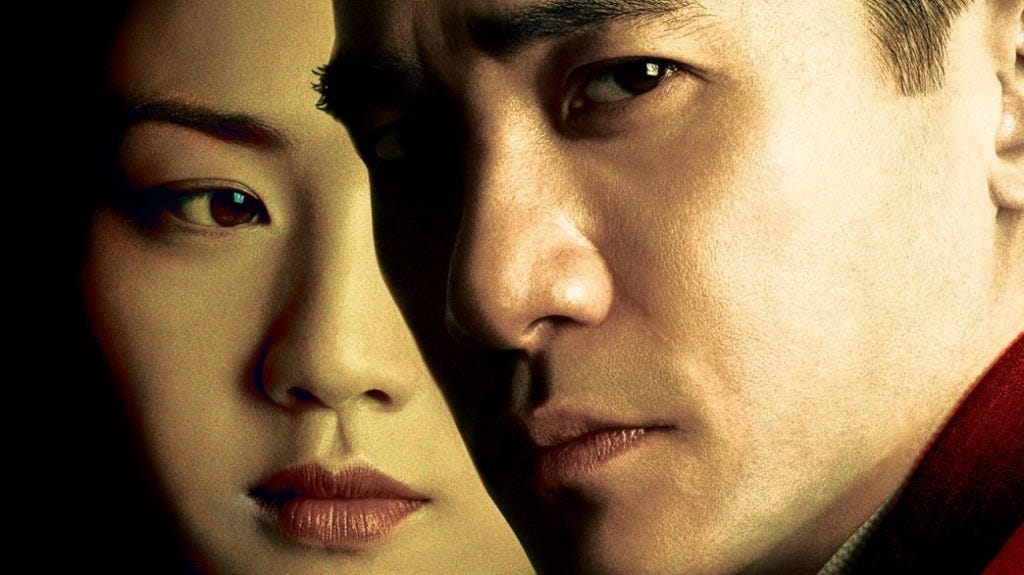
- Lust, Caution; Caution, Lust –
▼
The film Lust, Caution tells a tragic story about the loss of homeland and complex human interaction in war.
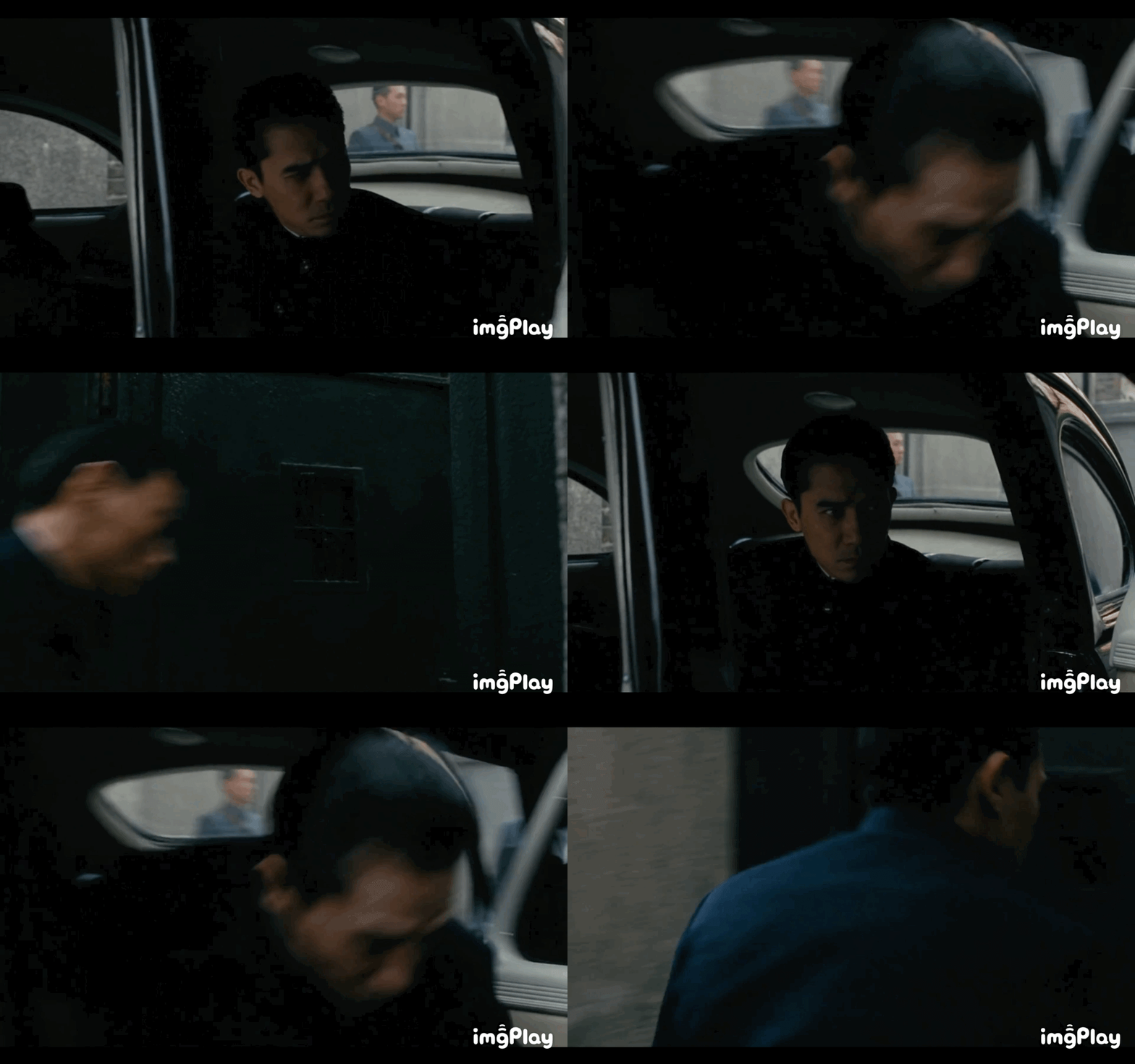
The story takes place in Japanese-invaded Shanghai and Hong Kong during the War of Resistance Against Japan in the 1940s. The first half of the film takes place in Hong Kong in 1938, opening the scenes to Lingnan University students Wang Jiazhi (played by Tang Wei) and Kwong Yumin (played by Leehom Wang) studying in Hong Kong to escape the war. They joined a local drama club and planned to assassinate a traitorous governor Yi Mocheng ("Mr. Yi", played by Tony Leung), who worked for the notorious pro-Japanese government. The Hong Kong part of the story is mainly about students trying to look rich and faking the roles of rich business couple “Mr. Mak and Mrs. Mak" to prepare for their immature assassination. Wang Jiazhi had no previous sex experience. To better get ready to seduce Mr. Yi, Wang had to break her virginity and sleep with fellow student Liang Runsheng, who had limited sex experience with prostitutes, and practice for more sex and thus sex appeal. The story in Hong Kong describes a series of haste and childish preparations for the assassination. In the first assassination attempt, the students tried to trick Mr. Yi into the apartment and kill him, but the highly trained Mr. Yi declined. Here Tony Leung's acting skills shine all the way. You can hardly imagine that this is a character performed by an actor. As a big high-level traitor everyone wanted to assassinate, Mr. Yi lived in a highly mysterious and tense life guarded by the highest security. Tension can be seen everywhere in Yi’s eyes. For example, Yi/Leung quickly scanned the surroundings with his eyes before going out of his car and entering a building. The original novel’s writer Zhang Ailing did not openly tell readers that Mr. Yi should suspect his surroundings with his eyes, but Leung’s painstakingly detailed performance shows how much effort the actor has put in analysing the characters behind the scenes.
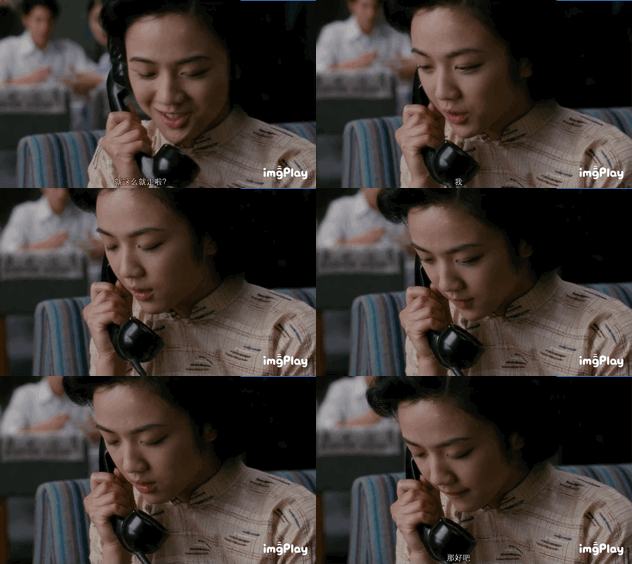
It was also not easy for the lead actress Tang Wei, then only a fledgling actress with minimum acting experience, to play against one of the most achieved Asian actors in a master-directed drama. Because Mr. Yi's family precipitously decided to leave Hong Kong (in fact, they had been preparing for a long time but only notified "Mrs. Mak/Wang Jiazhi" last minute), Tang Wei's acting skills exploded. In just one phone call, Tang Wei brought to life the powerlessness of a young student trying her best to negotiate but magically alter Yi's family’s move. This phone-calling plot is added. In the original book, it is just a few sentences without a dialogue. Ailing Zhang spent no time writing Wang Jiazhi's "extreme embarrassment" on the other side of the phone.
Four years later, in 1942, the students reconvened in Shanghai. Mr. Yi's family also returned to Shanghai. Living in financial distress, Wang Jiazhi reunited with Kwong Yumin, who was already a special agent of the Chongqing National Government (CCP-led anti-Kuomintang and anti-Japan government). She accepted the task of re-starting the assassination attempt of Mr. Yi. This time, opportunities are better. The Chongqing Government had a much smoother organisation behind the arrangement and provided skilful training. Guided by better resources, Wang Jiazhi succeeded in impressing the stressed womaniser Mr. Yi with her beauty and sex appeal.
The evolving relationship between Wang Jiazhi and Mr. Yi is casted through three sex scenes that made a worldwide audience hold their Bible and earned the film the NC-17 rating. The revealing sex scenes serve as a line that helps string together the climbing relationship between the duo. There are no such sex scenes in the original novel, at least not in an apparent way that almost equal to the Pornhub quality. There are certainly no lines in the original book discussing any sex positions. Zhang Ailing's described Wang Jiazhi's seduction to Mr. Yi more as her pursuit of him. Because he was too busy, there were "too many temptations... If you miss one, you will be left behind... You need to lift two breasts and dangle in front of his eyes." Other than that, there is not much to be read. However, the sex scenes in the film Lust, Caution are precisely the main course. The movie gradually climaxed after the sex scenes appeared. With every explicit scene, the nuanced relationship between the male and female protagonists was also changing. Japan in the context of the time was approaching a dead end as its invasion was fought back by a fierce domestic resistance and international collaboration. The fate of the Japanese puppet Mr. Yi was also going downhill. However, the relationship between Jiazhi and Mr. Yi was climbing to a peak that would soon drop like firework.
The first sex scene is rude. After Wang Jiazhi came to Mr. Yi's place, she and Yi first had an intimate chat. Then, Mr. Yi bundled Jiazhi rudely, and quickly resolved the battle in absolute power (dog position). In the first love scene, Wang Jiazhi enjoyed little, as she was obviously abused and disrespected.
For the second sex scene, the relationship between the two improved. The scene opened with various more equal positions such as the straddle and face to face.
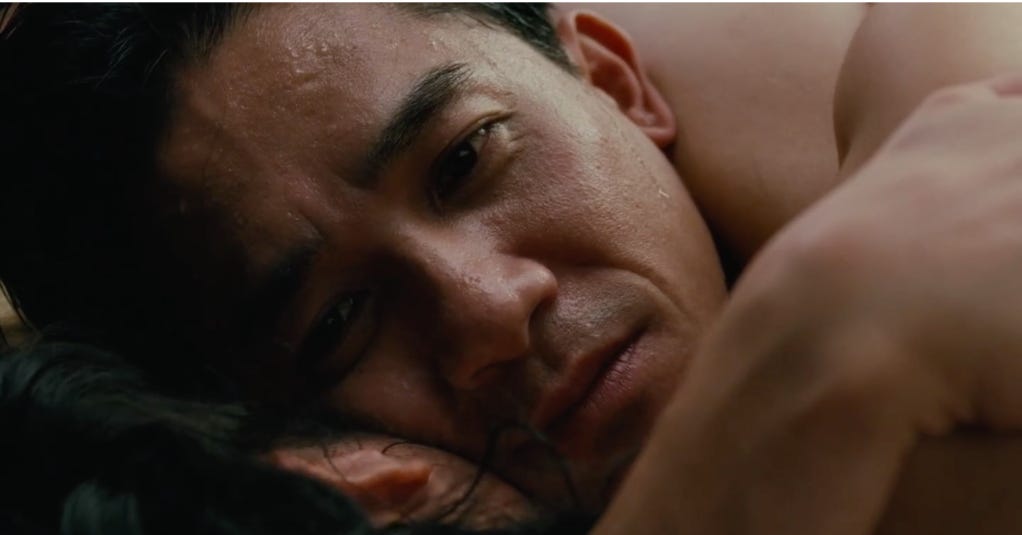
The third sex scene coincides with the climax of the relationship. In the third and the most fierce and exciting sex scene, Wang Jiazhi was in the woman-on-top position most of the time. She even glanced at the gun hanging on the wall at the end. Its meaning couldn't be more self-manifesting! Nevertheless, Wang Jiazhi did not act on it. This is an allusion to her eventual decision of letting Yi go in the last assassination attempt. In the third scene, although Wang Jiazhi occupied the upper position most of the time, in the end Mr. Yi turned her over and ended the scene with himself as the superior.
After that, Ang Lee added the plot of a night of the two at the Hongkou Izakaya. There is no such plot in the original book. At the movie presented time, the country was ruined, but Hongkou, a common gathering place for Japanese and the rich, still saw singing and dancing every night. The torture and suffering of most of the Chinese had nothing to do with the luxurious lifestyle of a small number of those in power. Adding this plot allows the characters to naturally connect and seamlessly be in love. The izakaya was extremely noisy, filled with drunk Japanese generals and guests. Mr. Yi and Wang Jiazhi were in a separate room. Wang Jiazhi sang Zhou Xuan's Singer of the End (1) for Mr. Yi. Wang Jiazhi had no home, and Mr. Yi betrayed his homeland to the enemy. As he said, he lived like a “prostitution”, who disregarded loyalty and traded for money. The two were facing each other, and their situation was so similar in this troubled world. Mr. Yi had power, but the losing came from his exchange of righteousness with supports from the invasive enemy. Wang Jiazhi was "Mrs. Mai", a stolen identity. In fact, she was poor and her fate was a floating lotus in an ocean. Their situations were similar and so their souls found solace in each other.
Lust, Caution is rich in details, visualising many unexplained backgrounds and sentiments in the book through a fine lens, added plots, and the masterful play of actors and actresses. The Eternal Life Palace in Suzhou Pingtan, a song played at the background during a scene the governors’ wives played mahjong, alluded to the story of Emperor Ming and Concubine Yang (2). Isn't the lyric " the powerful Tang emperor on the high horse" for-shadowing Yi's ultimate finale of failing to save his beloved, like how Emperor Ming failed to save Concubine Yang?
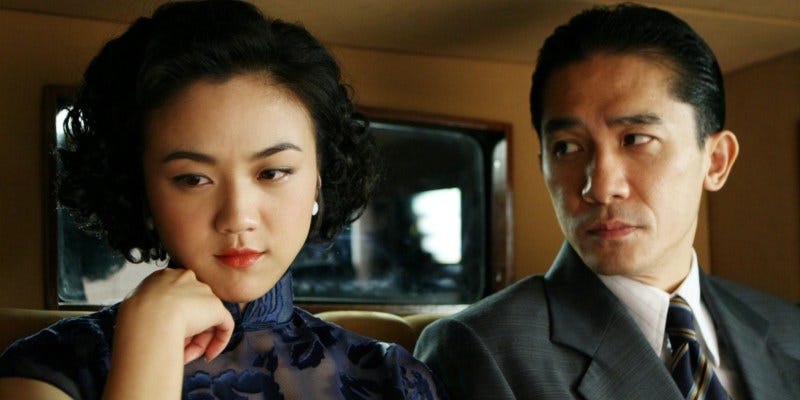
The casting is also wonderful. The original novel mentioned that Wang Jiazhi is "half a head taller than him (Mr. Yi)" in high heels, so Ang Lee chose the taller actress Tang Wei and the shorter actor Tony Leung. The director casted the inexperienced Tang Wei for the innocent but sexy oriental woman Wang Jiazhi. He also casted the Cannes-winning Tony Leung, who has developed a highly sensitive and fine acting skill and who is able to assimilate into any character, to play the multi-faceted Mr. Yi. Wang Jiazhi cannot be played by any random female star, because experienced actresses may have difficulty faking her naivety. For Mr. Yi, the original book described too little about him. The Jiazhi-perspective book wrote about Yi’s power, ugliness, and lust in a few lines, but it has not stated his sadness and weak sincerity that sometimes resonates with Wang Jiazhi. To play Mr. Yi, the actor needed to read immensely about Hu Lancheng, a complicated reallife historical figure and the novelist Zhang Ailing’s grand lover, and of that era. Prior to shooting, Ang Lee assigned tasks to the actors and actresses and asked them to immerse themselves into the related books. These careful and thorough preparations were the founding stone for the achievement of one haute artistic level of the film. Mr. Yi without Tony Leung is very ugly, traitorous, disgusting, and complacent, as the book says, he "sits upright on the surface, but (he is) ecstatic in secret". In the film, the highly charismatic Tony Leung, despite being dressed up by the greasy hair and dark makeup, managed to add a sense of being a human being and tiny slew of charm to the otherwise unattractive and aged Mr. Yi.
Wang Jiazhi warned Mr. Yi last minute during the last assassination attempt so he managed to escape. The scene of Mr. Yi/Leung’s life-threatening escape made people immediately feel the disillusionment of home country, sex, and his rare feeling of love. Finally, Wang Jiazhi and his accomplices were arrested and executed before 10 pm on the same day. Mr. Yi tried to reconcile his mistress’ execution through a complex contemplation in the last bit of the film. In the original book, Zhang Ailing described the relationship between Mr. Yi and Wang Jiazhi as "the tiger and the ghost (Wei Hu Zuo Chang)", which leads to an "ultimate possession". The ghost (Chang) is eaten by the tiger but the ghost helps the tiger to lead more people to be eaten by the tiger. The tiger relies on the ghost, and the ghost on the tiger. In the book, Yi considered that Jiazhi being "alive is his man, dead is his ghost". Jiazhi’s betrayal of the revolution allowed Mr. Yi to obtain comfort as he pondered over and thus felt glad that he, a mid-aged socialite man, managed to get a woman to truly love him not his power or money. He thought he was a real man to get on hold of a love of a "pink confidant".
At the end of Lust, Caution, Mr. Yi returned to Wang Jiazhi's former room before walking out. This is not the plot in the original book either. The ending shot travels through countless mirror images, lights, shadows, which explore the murkiness and brightness of the Lust, Caution world. Ang Lee tells a story about being involuntary and unable to secure one’s fate in a jittered world.
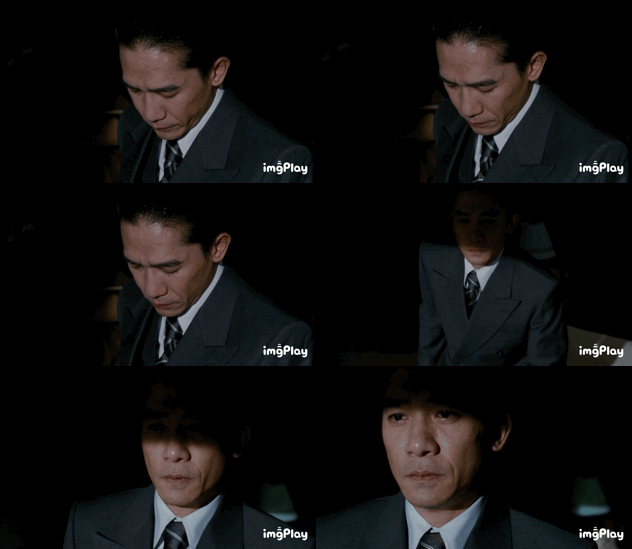
Is the film about lust? It is. Is it about the relationship? Admittedly. Is it about the reality of war, revolution, and betrayal of revolution? Mr. Yi once went to study in Japan to follow in the footsteps of Sun Yat-sen (pro-Chinese independence pioneer), but he in the film was a senior official of Wang Jingwei's pro-Japanese government. Wang Jiazhi had been full of passion and patriotism, but she gave up her mission for the sake of love. I am not sure if we can blame the characters for their course of action, because the revolution was indeed too idealistic for the average men to hold on to. The time did not give the protagonists a chance, and the characters did not stand with their grit.
Finally, the premier of Lust, Caution set off a shock wave in the pan-Chinese society. The government banned the actress Tang Wei from working in the entertainment industry. Fortunately, the actress finally found recognition through other works. The ban was also unfair, because the society were not harsh on the actor Tony Leung and the Oscar-director Ang Lee. The film did not encroach the men’s reputation; instead, their future was even more colourful and their talents more nodded on. In fact, the novel Lust, Caution extracts a short section of Zhang Ailing's own story. The script of the Lust, Caution movie combines a part of Zhang Ailing's own life, and the prototype of Wang Jiazhi also takes reference to the real historical figure, the 22-year-old executed patriot Zheng Pingru. The latter did not hesitate to assassinate the traitor and she braved death calmly after being arrested. Lust Caution itself is a gloomy and heavy story, but the real female staff that created it are unique and vivid in their respective eras.
The film has too many oriental details that make the masterpiece shine and makes it hard for the Western audience to digest. The movie has earned a far underwhelmed appreciation no matter in the east or the west. Perhaps its R-rated scenes make film critics afraid to mention of the film. Nevertheless, the movie should not be viewed by a perception of R rating because of scenes, as the craft itself contains so many refined and sublimated nuances. The music is created by the Golden-Globe-winning French musician Alexandre Desplat. To match the tension of Lust and Caution, he combined the experience of France in World War II. When one searches online for Lust, Caution in China, the majority of the news announcements are gossips about Tony Leung and Tang Wei's “fake play turned into real action” in sex scenes. This is such an underrated commentary on the masterpiece. I hope this top-notch movie deeply expressive of oriental thinking can be better appreciated in both the eastern and western worlds.
-Some Other Oriental Erotic Films (by the Order of Preferences)-
▼
-The Korean movie A Frozen Flower may be a lesser version of Lust, Caution. It tells the story of King Goryeo (played by Joo Jin-mo), the Korean king under foreign (Mongolian) pressure and his struggle with his homosexual lover and nominal wife during the Goryeo Dynasty. The shots of the film are exquisite, and the main actors (Joo Jin-mo, Jo In-sung, Song Ji-hyo) are also very skilled in acting. It's a pity that after the movie came out, Ji Hyo's career path went to a low point until Running Man gave her a career revival. In A Frozen Flower, in fact, the most explicit and break-through scenes were not taken by Song Ji-hyo, but Jo In-sung. He assumed the role that had two love lines (and thus two love-making settings), one with the queen (Song Ji-Hyeo) and one with the king (Joo Jin-mo). The film is good, although incomparable with Lust, Caution.
-The French romantic drama film L’Amant (The Lover) tells the story between a sexy and charming oriental man played by Leung Ka Fai and a young French girl in French Indochina in 1929. The original L’Amant book is a delicate semi-diary. The film adds discussions on economic status, colonies, and family life. It is a good film adaptation. The actress Jeanne Moreau just turned 18 when she was in the film. The actress said that the industry had an inappropriate practice on her work judged by today’s standards. Although the actress could have completely refused the shooting of many shots, the young actress shot it anyways. The movie’s love scenes are beautiful and misty like the heat of Saigon. The film is all right; it's also a classic work by now.
-The Thai movie Jan Dara is closer to a Pornhub video than to the artistic film. Many Chinese audience came to watched the sexy actress Christy Chung's sensual role Boonlueang. The film is filled with too many R-rating scenes, potentially for the fact the original book itself is a pornographic book. In fact, the movie deepened a few themes unexplored by the book, including thinking about family relationships, abuse, and the backdrop of the World War II. Jan Dara is the protagonist’ name meaning evil in Thai. If there is a superb screenwriter to rewrite and convert this little porno book to a better script, perhaps the new movie can have a higher artistic appreciation beyond a porno.
*
(1) the song sings of a singer's homeless life after her home country was invaded
(2) Emperor Ming was forced by his revolted troop to kill his favourite woman Concubine Yang, who had been a scapegoat for his own fault.