
The Falling of the American Freedom Eagle - An Evaluation of Anglo-Saxon Jewish Expansionary Thoughts in Palestine

According to the New York Times news on May 1st, the night before, the New York police blocked the pro-Palestinian student movement at Columbia University, citing damage to school buildings, and detained students. On the same day in Los Angeles, police took UCLA students away for “multiple acts of violence within large encampment.” The student tents at UCLA continued to be set up, and on Thursday the student movement intensified as California police carried on maintaining order and arresting students. Two days ago on Tuesday, May 7, a student movement broke out at the University of Chicago, and at 5 am the police intervened to clear the tents.
A single spark can start a prairie fire, as the saying goes from the Mao Zedong’s Assessment of the Current Situation and Questions Concerning the Armed Struggle, although it may not be entirely fitting here, as Mao’s rather shrewd and cold-blooded strategies carry much more political agenda than a student movement, and discussing the American student movement in terms of the Red Army’s seizure of power would be a different matter altogether. Nevertheless, if we open up a map of the current student pro-Palestine movement, we can see the sparks of the West and the flames of the East united in one piece.
The idea to talk about the “fall” of the freedom eagle came to me after a string of conversations and of course months of following the thread. My business partner and team are at universities in the East Coast; because we are doing something closely residing in the Middle East, when the blended label of being student and matter of the Middle East, discussions naturally waded through. As someone that has benefited from the libertarian “critical thinking” in these schools, I am proud to see how students bravely protest against the government as tax money should not be used to financially support indiscriminate bombings of Palestine. From the wave, there are similarities between the throwback of the anti-Vietnam War movement of the past; decades of war, lies from politicians and the media’s cover-up are no longer accepted by the youth today.
Is the pro-Palestinian movement merely about supporting Palestine as a country? Every anti-elite, anti-war movement is rooted in dissatisfaction among the public or a specific group toward the establishment. In this spreading student movement, it reflects decades of discontent against the Anglo-Saxon-Judeo-Christian forces that have dominated and enforced “power”.
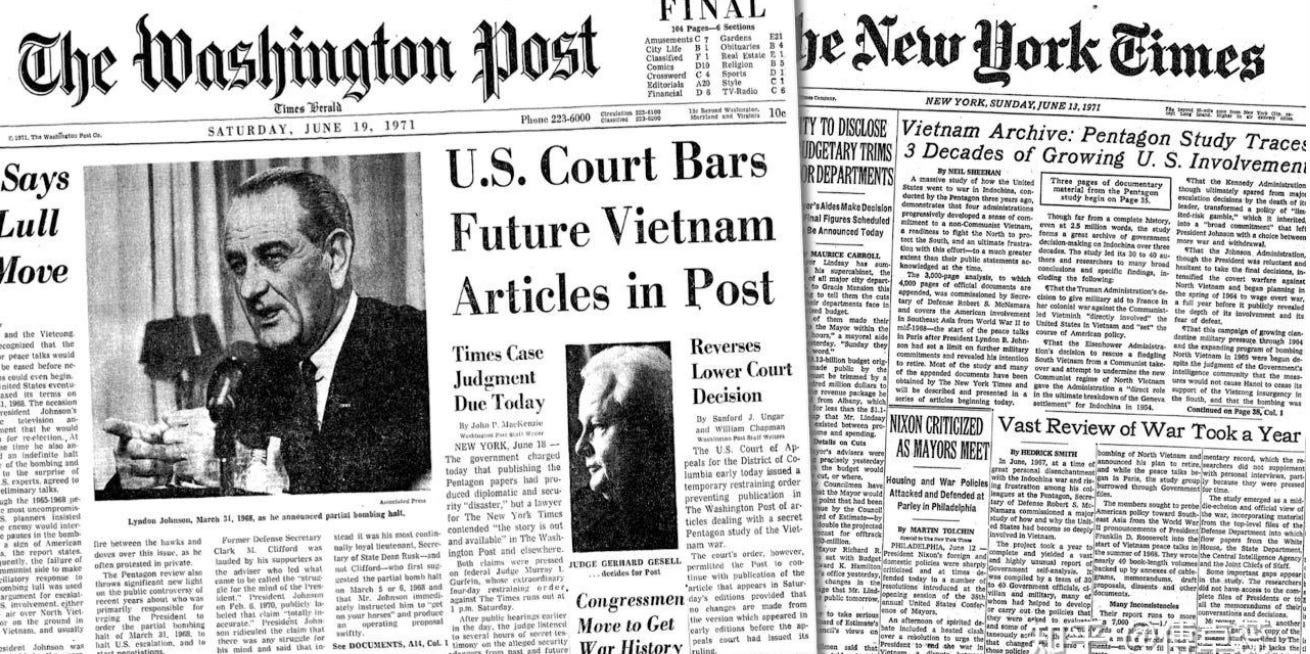
The U.S. government and media once had a monopoly on information, covering up the truth during the twenty-year Vietnam War; from Truman to Eisenhower to Kennedy to Johnson to Nixon, politicians and the establishment spread lies and manipulated public emotions via inciting fear of communism, which got backfired with public resentment. This began with student movements, then spread to punk culture, vividly depicted in Forrest Gump, and finally led to the Washington Post publishing the Pentagon Papers, which exposed the White House’s hidden strategies on the Vietnam War. That was the last major battle between civil rights and “democratic authoritarianism”. Back then, it wasn’t the era of social media; hippies acquired information mainly through television and radio. Today, social media is everywhere, and those experiencing the war can upload real-time and fresh content through platforms like TikTok. We no longer live in the era of Kingdom of the Heaven when the pope’s command could start a crusade; now we can see the full spectrum of opinions and viewpoints. Propaganda is no longer the mainstream voice; instead, diverse opinions flourish. No amount of doctrine or slogans can explain why children, women, the elderly, and the poor are being massacred in large numbers. Hundreds of thousands of Gazans live in constant fear for their lives, with many videos showing Israeli soldiers treating civilians, prisoners of war, and corpses inhumanely, which are uploaded online as a trophy of war by soldiers rather than demonstration of human tragedy. Despite decades of conflict, in this war, the lack of intelligence networks has led the Israeli military to fail to accurately target Hamas, resulting in widespread devastation among civilians. Nonetheless, combating extreme crimes cannot justify committing another form of collective extreme crime.
After 9/11, the Anglo-Saxon elite labeled extremism as “terrorism.” Although extremism is indeed abhorrent, the term “terrorist” has since become a political label used by administrations. Opponents branded with this label, regardless of whether they are actually extreme, are treated with “decapitation” tactics. The downfall of Saddam Hussein and Muammar Gaddafi in real life are good examples of such removal of dissidents. Scenarios like this are also depicted in TV series such as Homeland and House of Cards, which add a flavour of drama but do not lose authenticity.
Noam Chomsky elaborated on the relationship between the press and the government in his book Media Control. He stated, “propaganda is to a democracy what the bludgeon is to a totalitarian state... probably on the order of a billion dollars a year on it or something and its committment all along was to controlling the public mind.”
Chomsky rose to prominence during the anti-Vietnam War period and has since dedicated his scholarly work in linguistics and politics. The Western, and especially US business elite politics and media propaganda machine are supreme in quality and deft in yielding subtle influence. When these propaganda machines are used to whip the people, we know that 1984 is not limited to totalitarian states. The American ideal of equality has been disappointing in the context of the Israeli-Palestinian conflict, especially after numerous foreign wars (more accurately, satellite wars fought outside the homeland). Before, Lincoln stood at Gettysburg and proclaimed equality and freedom for all (”a new nation conceived in liberty, and dedicated to the proposition that all men are created equal”). Now, this freedom is found to be stratified by race, skin colour, and religion. Do the Gazans driven to Rafah have freedom? Are the Muslim children who died in airstrikes born equal?
The constitutional maxim that private property is sacred and inviolable (no person shall be... deprived of life, liberty, or property without due process of law) is something I have faithfully upheld as a doctrine, to the point of arguing with my partner over my belief in the law. But a turning point has quietly arrived—what if this “private” property is not divided by secular law, but by the interpretation of the Bible?
Colonialism is an unavoidable topic in the Middle East. Behind the endless yellow sand and barren lands of the Middle East are the scars left by a century of colonialism. Today, that history continues to affect all aspects of life for the people of the Middle East, and the Israeli-Palestinian conflict is a microcosm of this, as well as a manifestation of the clash between great powers.
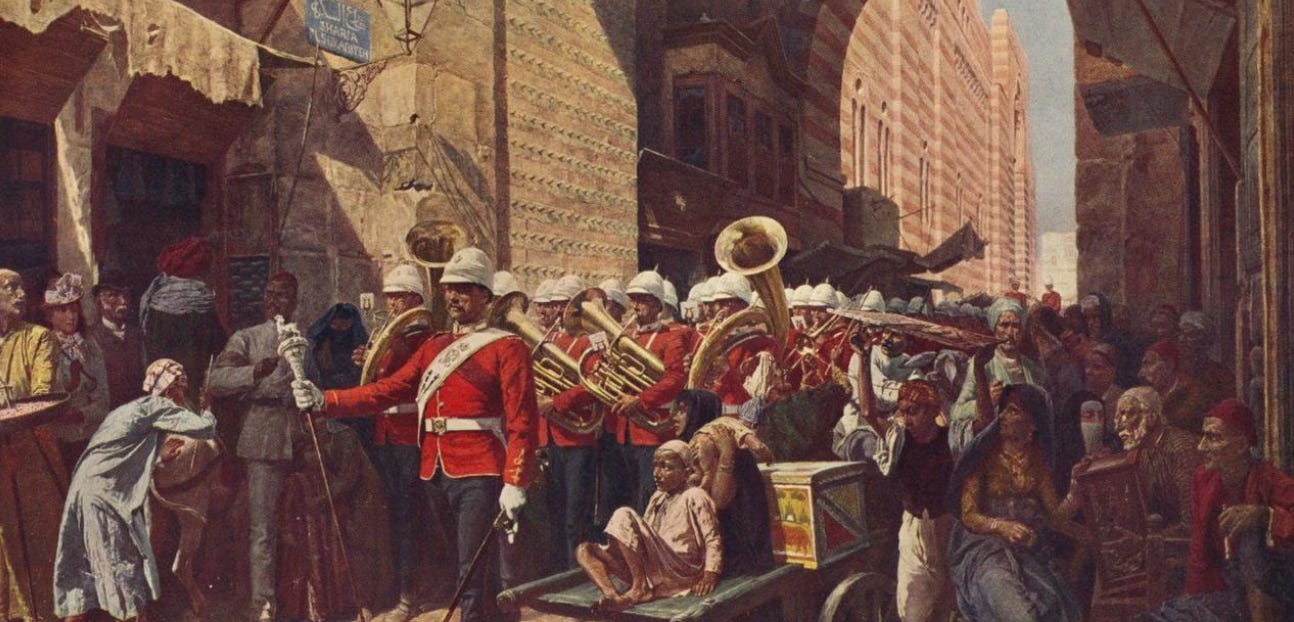
Religion has always been at the heart of the Western culture. Going back to the distant Crusades, by the name to support the Byzantines, Europeans carried out the Pope’s orders and clashed with Muslims at many strongholds. Later, the Age of Exploration began amid and post Enlightenment. The budding industrialism and capitalism, combined with the power conferred by religion, spurred Europeans to compete for new territories. These territories were not uninhabited but were home to indigenous civilisations. The concept of “crimes” did not apply to the atrocities committed by the Spanish in South America at the time; even the term “colonies” itself is derived from the Spanish summary of the “uninhabited” lands they occupied. Modern historiography encapsulates Spanish expansion in South America with three words: “Gold, Glory, God.” Gold represents capital, glory celebrates royal power, and God provides justification. The Anglo-Saxons also had their own gold, glory, and God, but they were more astute, establishing a commercial empire across the globe. Today’s laissez-faire economic backbone largely stems from the criticisms over Mercantilism. Although the new America drove the British army back across the Atlantic through wars and aimed to establish a nation entirely different from the old British order and system, America’s later politics and diplomacy have consistently highlighted one thing: the Anglo-Saxon religious, colonial, and mercantile thoughts are deeply engraved in American history alongside the founding fathers’ Constitution.
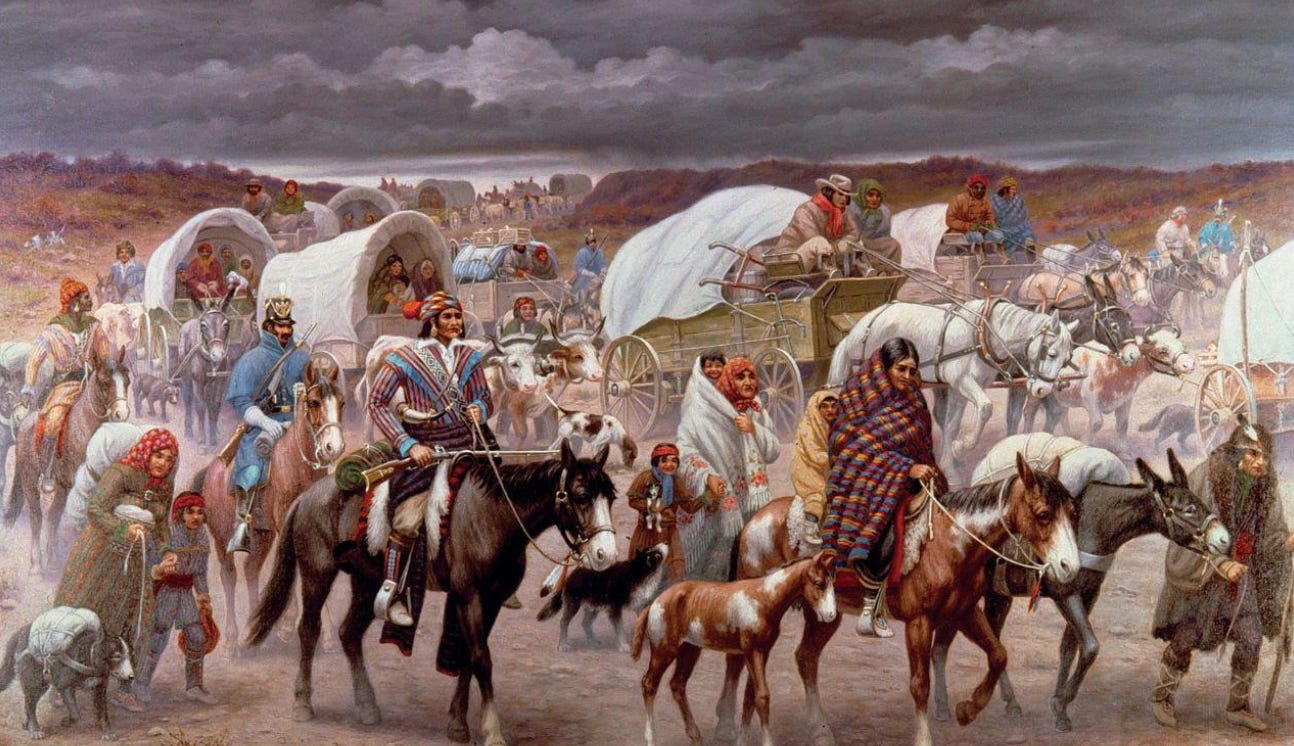
If the early 13 American colonies represent the New British—or American—reflection on the new world order, then the subsequent rapid Westward Expansion almost draws a reference paralleling to the past Israeli encroachments on Palestinian territories. The transformation of American territory from a few pieces of New England lands to the vast nation it is today owes much to the “hard work” of Americans expanding westward. Of course, Native Americans see this as a disgrace. The Indian Removal Act signed by Jackson in 1830 found its “rebirth” in another form on Nakba Day in 1948. Wherever the Gospel reached, it revealed the Manifest Destiny. The American westward expansion and the displacement of Native Americans were all “legal”, but didn’t this directly contradict the Constitution’s assertion that private property is sacred and inviolable? Weren’t Native Americans’ private property and land considered property? Wasn’t this illegal? Well, under the mandate of Manifest Destiny, Native American rights were not equivalent to those of the American white citizens. Biologically, they might both be humans, but sociologically, 19th-century Anglo-Saxons perhaps did not want to believe the two were equals.
During the late Ottoman Empire, the rulers attempted reforms as the central empire’s control over peripheral regions began to crumble from Egypt to Levant to Palestine. After the Tanzimat Reforms, Jews started moving into Palestine, undergoing five major Aliyah movements. However, the real large-scale return of Jews to Palestine is largely due to the rise of Zionism. Today, Zionism in Western academia and popular discourse often evokes strong reactions. The Zion is no longer the heroic resistance base in The Matrix or the land King David conquered in the Tanakh. Instead, it has become a symbol of modern Israeli neo-colonialism, as the Jews and, later, the state of Israel, moved into Palestinian land over the past century. The justification is almost identical to Manifest Destiny: because God granted me this power, you have no right to private property.
Today on YouTube, there are countless videos showing how Jews forcibly taking over Palestinian homes. When asked why they are being evicted from their own homes, a common response from the invaders is, “This is my right; if I don’t take your home, someone else will.” These videos often include references to Israeli court rulings. Israeli residents, holding court decisions, explain how they waited through the legal process for years and only came to reclaim their rightful homes after receiving a “yes pass” from the court. However, this procedural justice has a degree of hypocrisy, as it is unclear whether the court’s decisions took into account the testimonies and appeals of Palestinians. The Palestinians interviewed in these videos often express a deep sense of powerlessness.
Just as how the persecution of Jews during World War II are well-documented, there are numerous accounts of Palestinians and their descendants (often in exodus) describing how their homes were taken away.
A common argument among pro-Israel supporters today questions the legitimacy of Palestine as a state. Indeed, the region of “Palestine” has historically been under the control of various empires and has never truly been an independent nation. However, this land carries the weight of history, having seen the passage of many Jews, Arabs, Arab Jews, and Jewish Muslims over thousands of years, whether under the rule of great empires or on the fringes of conflict. If we have to use past history or even the allegories of the Tanakh to dictate the lives of people today, it never has an end.
Violence must always be condemned, even though human history is replete with the futility of an eye for an eye and a tooth for a tooth. The grand narrative of human history is one of conquest, abuse, suffering, plague, separation of families, and blood. However, humanity is progressing. A while ago, I was talking with a Middle Eastern studies friend I deeply respect. He said, “Were the two world wars fought in vain?” as we conversed about the subject. Before the age of modern media, sacrifices and invasions might somehow be glorified, and sovereign war was an obligation but not a choice. In the past, in the late Chinese imperial history alone, there were double digit millions that perished during the White Lotus Rebellion, Taiping Rebellion, and Boxer Rebellion. Today, with economic diversification and technology enabling prosperity, the media vividly display bloody massacres instantly before our eyes. How many people can truly remain indifferent to slaughter? Aaron Bushnell could have had a happy life; his self-immolation was a condemnation of large-scale violence. With his life, he warned us that large-scale violence to combat extreme crime is not feasible in today’s society.

Moreover, countless people raise their voices in protest, shouting, “I won’t be complicit in wars.”
Hamas’s infiltration is a bone-eating maggot. Long ago, I wrote a paper in school focusing on the existence and infiltration of extremist groups like ISIS. I understand that extremist organisations are difficult to identify, contain, and eradicate. Israel’s claim that Hamas uses women and children as shields is not unfounded. In the Middle East, Iran’s theocratic government and military satellites are pervasive in potential conflict zones, continuously harassing Israel from the north. Iran’s stated reason is retaliation, even threatening preemptive strikes, similar to the U.S. invasion of Iraq and Russia’s actions in Ukraine. In the Middle East, everyone fights for survival and retaliation is such “justified” fight for survival. Extremists in a way can also find roots of their formation in marginalized people in societies. But like murder, no matter what are the reasons behind it, once the act is committed, it needs to be punished by law.
In any case, the American eagle of liberty has fallen in Palestine, and the Anglo-Saxon sun has set on the eastern Mediterranean. Even though the freedom gospel echoes worldwide, from Jackson to Wilson, Monroe to Truman, Roosevelt to Bush, the deaths of pagan children, women, and civilians have never been placed within the realm of freedom; that’s why the military can sing a melody of retaliation while committing acts of violence. Lord of War uses an African story to show us the heartbreaking truth of every war: “I do rub shoulders with some of the most vile, sadistic men calling themselves leaders today... you call me evil. But unfortunately for you, I’m a necessary evil.”
(Wrote this article in May; original in Chinese; translation and recreation into English assisted by AI; pictures are from online)